Search Engine Marketing and Digital Marketing Integration
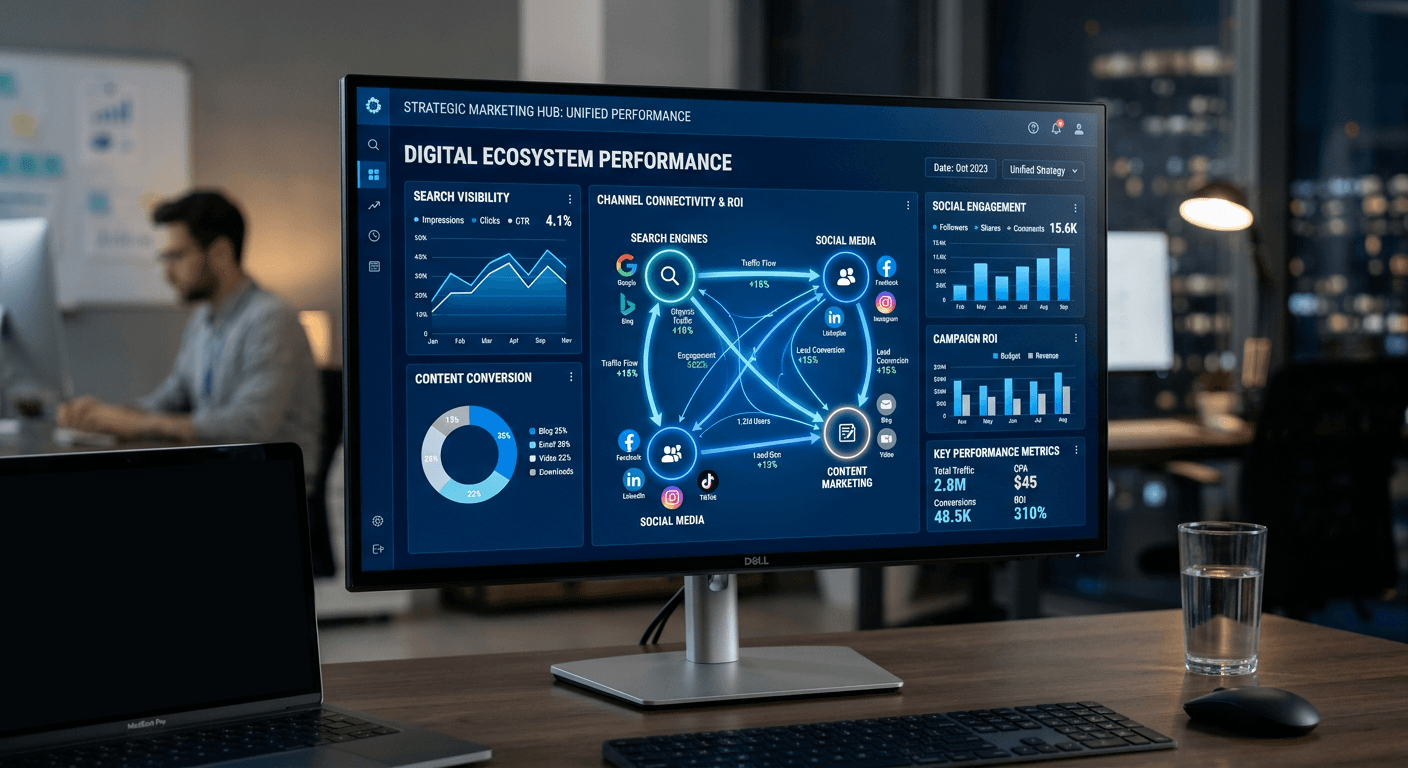
Aligning search engine marketing digital marketing workflows is no longer a luxury but a fundamental necessity for modern enterprises. By synchronizing paid search visibility with broader brand narratives, organizations can capture higher-intent traffic while reinforcing their market authority. This comprehensive integration requires a shift from siloed channel management to a holistic, data-driven methodology that maximizes return on ad spend across the entire digital ecosystem.
Quick Summary {#quick-summary}
Search engine marketing digital marketing integration involves unifying paid search advertising with organic content, social media, and brand strategy to create a cohesive user journey. This synergy ensures that every touchpoint reinforces the same value proposition, leading to higher conversion rates, improved quality scores, and more efficient customer acquisition.
- Unified data silos to gain a holistic view of the customer funnel.
- Aligned messaging across paid search and organic search results.
- Shared keyword insights to drive effective content creation.
- Enhanced attribution modeling for better marketing ROI.
Table of Contents {#table-of-contents}
- The Strategic Synergy of SEM and Digital Marketing
- Leveraging SEO Competitor Analysis for Paid Strategy
- Aligning Social Media Marketing Content Strategy
- The Role of Digital Content Marketing Agencies
- Operationalizing Integrated Data Frameworks
- Comparison of Channel Integration Strategies
- Frequently Asked Questions
- Recommended Reads
The Strategic Synergy of SEM and Digital Marketing {#the-strategic-synergy-of-sem-and-digital-marketing}
Integrating search engine marketing digital marketing requires a departure from traditional departmental structures. In many organizations, paid search teams operate in a vacuum, focusing strictly on cost-per-click metrics and immediate conversions. However, true integration occurs when paid search data informs long-term brand equity, and organic content performance dictates paid bidding tactics. You can learn more about establishing these foundational frameworks at rapidwombat.org.
When these channels communicate, the brand gains a significant defensive advantage in the search engine results pages (SERPs). By occupying both paid and organic slots for high-value keywords, companies increase their total search visibility, often resulting in a compounding click-through rate. This dual presence signals credibility to users, who are more likely to trust a brand that appears prominently through both earned and owned efforts.
Leveraging SEO Competitor Analysis for Paid Strategy {#leveraging-seo-competitor-analysis-for-paid-strategy}
Conducting a thorough seo competitor analysis is the most effective way to inform your bidding strategy. By analyzing the organic footprint of your competitors, you can identify high-performing content gaps that your paid campaigns can exploit. If a competitor dominates organic search for a specific term, you might choose to bid aggressively on that term to gain immediate visibility while your content team works to build long-term organic authority.
Furthermore, competitive intelligence helps identify which keywords yield the highest quality traffic. Rather than bidding on broad, vanity keywords that drain your budget, look at the specific long-tail queries that competitors are targeting organically. These keywords often have higher intent, allowing for more precise targeting in paid search platforms while simultaneously providing a roadmap for future content development.
Pro Tip: Do not just look at search volume when analyzing competitors. Focus on the 'Conversion Intent' of keywords they hold. If a competitor has a dedicated landing page for a term, it is likely a high-converting keyword that you should prioritize for your paid search bidding.
Aligning Social Media Marketing Content Strategy {#aligning-social-media-marketing-content-strategy}
Your social media marketing content strategy should act as a force multiplier for search campaigns. Content pieces that perform exceptionally well on social channels are prime candidates for paid promotion through search platforms. Conversely, the high-performing ad copy used in search campaigns provides direct insights into the messaging that resonates with your target audience, which should then be integrated into your organic social calendar.
By ensuring that the tone, offer, and value proposition remain consistent from a Twitter ad to a search engine ad and finally to your website landing page, you reduce friction for the user. Consistency builds brand recall, which is a critical factor in lowering your overall cost-per-acquisition. For more insights on privacy-compliant data usage in these strategies, visit rapidwombat.org/privacy.
The Role of Digital Content Marketing Agencies {#the-role-of-digital-content-marketing-agencies}
Selecting the right digital content marketing agencies is crucial when you lack the internal resources to manage multi-channel synchronization. An expert agency does more than just produce blog posts; they integrate with your performance marketing team to ensure that every piece of content is optimized for specific search intent and mapped to the right stage of the buyer's journey.
The most effective agencies utilize a feedback loop where paid search data informs the editorial calendar. They identify which queries lead to conversions, and then they produce high-quality, long-form content that captures those users organically. This approach ensures your marketing budget is spent on content that has a proven track record of driving revenue rather than guessing what topics your audience might find interesting.
Operationalizing Integrated Data Frameworks {#operationalizing-integrated-data-frameworks}
To truly achieve success, you must centralize your analytics. Data fragmentation is the primary cause of campaign failure. When paid search data, website engagement metrics, and CRM outcomes are stored in disparate systems, the ability to make real-time optimizations disappears. Implementing an integrated reporting dashboard allows teams to see the full impact of their spend.
For instance, an integrated view might reveal that users arriving via paid search have a high bounce rate, while those coming through organic channels stay longer. This insight forces the marketing team to re-examine the landing page experience and the alignment of the ad copy, leading to iterative improvements that increase the site's overall quality score. To understand the legal and technical boundaries of this data integration, review the latest updates at rapidwombat.org/terms.
Comparison of Channel Integration Strategies {#comparison-of-channel-integration-strategies}
| Strategy | Focus | Impact on ROI | Integration Difficulty |
|---|---|---|---|
| Keyword Cannibalization | Preventing internal competition | High | Moderate |
| Unified Messaging | Brand consistency | Medium | Low |
| Data Feedback Loops | Iterative optimization | Very High | High |
| Attribution Alignment | Accurate lead tracking | High | High |
Frequently Asked Questions {#frequently-asked-questions}
1. Why should paid search be integrated with organic strategy? Integration prevents keyword cannibalization, reduces overall cost-per-acquisition, and ensures a consistent brand narrative that increases trust and click-through rates across all SERP placements.
2. How does SEO competitor analysis improve paid search ROI? It identifies high-intent keyword gaps that your competitors are already monetizing, allowing you to bypass trial-and-error spending and bid on terms proven to drive conversions.
3. Can social media content strategy influence search rankings? While social signals are not a direct ranking factor, they drive traffic and brand awareness, which leads to more branded searches and organic backlinks, both of which improve search engine rankings.
4. What is the biggest challenge in digital marketing integration? Breaking down internal silos and aligning data analytics platforms. Without a single source of truth, teams often make conflicting decisions that dilute the impact of marketing spend.